

Aluminum Cable Gland
GBAIL
Product Overview
Aluminum Cable Gland
Need metal strength without the weight? GBAIL's aluminum alloy body delivers the mechanical rigidity and professional finish of a metal cable gland at roughly one-third the weight of brass — making it the preferred choice for aerospace GSE, instrumentation enclosures, and weight-sensitive machine designs.
Paired with a high-performance PA66 nylon and EPDM seal assembly for reliable waterproofing, dust protection, and weathering resistance. Supports Metric, PG, G (PF), and NPT thread standards. Static operating temperature -40°C to 100°C; customizable to -60°C to 220°C wide-temperature version.
Key Features
- Lightweight aluminum alloy body: Metal strength at one-third the weight of brass — reduces total equipment weight
- Four international thread standards: Metric / PG / G (PF) / NPT — covers global equipment interface requirements
- Wide-temperature custom version: Customizable to -60°C to 220°C for extreme temperature environments
Technical Specifications
| Specification | Details |
|---|---|
| Body Material (A/C/F parts) | Aluminium Alloy |
| E-Part Material | PA66 Nylon (UL94V-2); V-0 upgrade available |
| Seal Material (B/D parts) | EPDM; customizable: cold-resistant / high-temp / acid-alkali / chemical / anti-corrosion |
| Working Temp (Static) | -40°C to 100°C (standard); customizable to -60°C to 220°C |
| Thread Standard | Metric / PG / G (PF / BSP / PS) / NPT |
| Key Feature | Lightweight aluminium body with metal mechanical strength and weathering resistance |
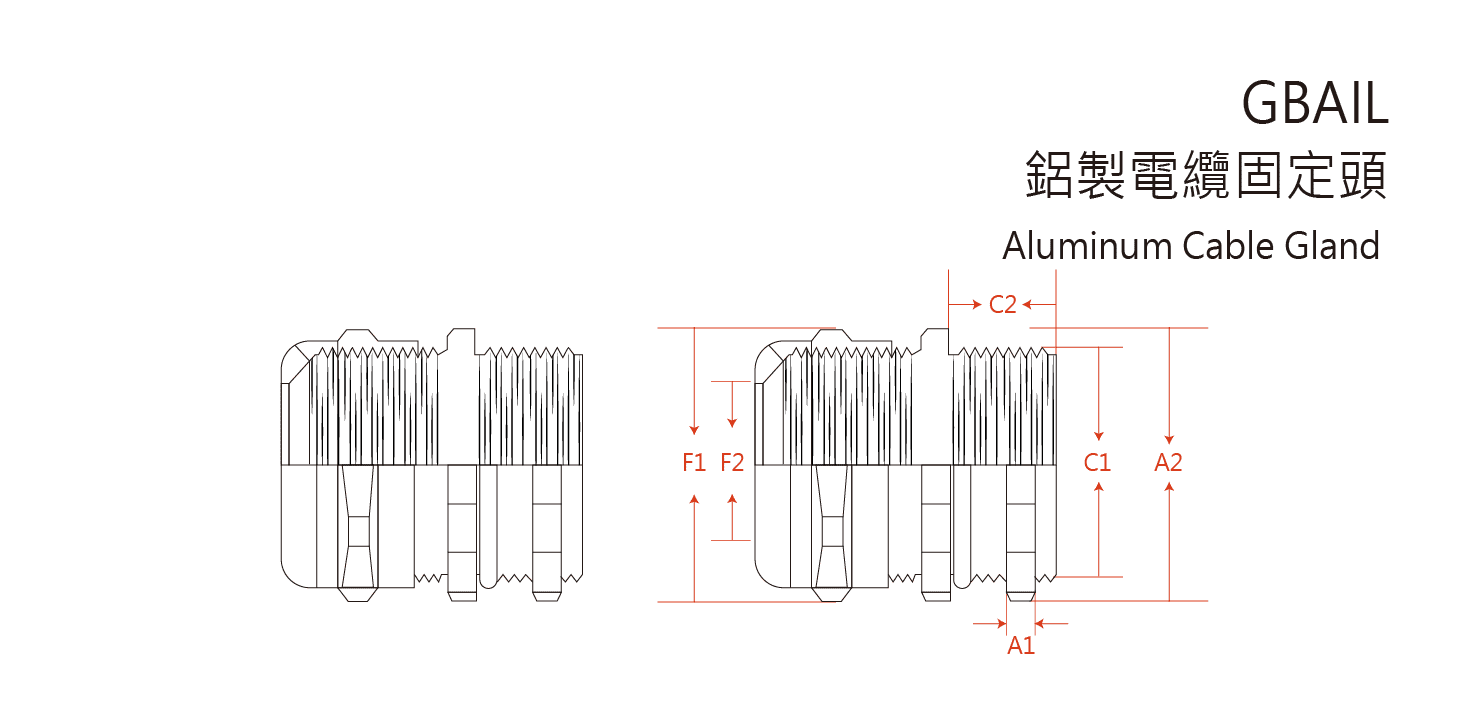
Engineering Drawing
Application Scenarios
Aerospace GSE / Instrumentation
Aluminum density is roughly one-third that of brass. For ground support equipment and instrument housings with strict total weight limits, GBAIL is the optimal lightweight metal cable gland solution.
Industrial Control Panels / Machinery
Metal body mechanical strength far exceeds nylon types — suitable for applications requiring metal housing ground continuity or higher mechanical strength demands.
Extreme Temperature Environments (Custom)
Wide-temperature version customizable to -60°C to 220°C — suitable for freezer equipment, furnace surroundings, or any application beyond standard temperature limits.
Frequently Asked Questions
Q1|What is the difference between aluminum and brass cable glands? When should I choose aluminum?
Brass density is approximately 8.5 g/cm³; aluminum alloy is approximately 2.7 g/cm³ — making the aluminum gland about one-third the weight of brass. If your equipment has strict total weight limits (portable equipment, aerospace GSE), GBAIL delivers metal strength while significantly reducing weight. Both aluminum and brass types offer mechanical strength that exceeds nylon. Weight requirement is the primary selection criterion.
Q2|GBAIL's standard operating temperature is 100°C. What if my environment is hotter?
GBAIL standard version is rated for static use at -40°C to 100°C. For wider temperature requirements, a customizable -60°C to 220°C version is available — suited for furnace environments, engine compartments, and other high-temperature applications. Contact sales with your application temperature and environment details to confirm the custom specification and lead time.
Q3|Which thread standards does GBAIL support? Can it be used for export to Europe and North America?
GBAIL supports Metric, PG (German standard), G (PF / BSP / PS — British standard), and NPT (American standard) — covering the major equipment interface standards used in Europe, Asia, and North America. No need to re-specify when exporting. Specify your required thread standard at the time of ordering.
Q4|Is GBAIL corrosion-resistant? Can it be used long-term in outdoor or wet environments?
Aluminum alloy develops a natural oxide layer that provides good weathering resistance in general industrial outdoor environments. The EPDM seal provides water and dust protection. In salt-spray or highly corrosive environments, consider the nickel-plated brass type (GQSSM) or contact sales to assess whether surface treatment (e.g., anodizing) is required.
Q5|Can an aluminum cable gland be used as an equipment grounding path?
Aluminum alloy has good electrical conductivity (approximately 60% of copper's conductivity). Metal-to-metal housing contact provides conductive continuity, making it suitable for EMC grounding or equipment housing grounding applications. For applications with specific grounding impedance requirements, contact sales with your conditions to confirm compliance with your grounding specifications.
Features
| {{ typeOne.merge }} |
|---|
| {{ itemOneTitle }} |
| {{ item }} |
Specifications
| {{ typeTwo.merge }} |
|---|
| {{ itemTwoTitle }} |
| {{ item }} |
| {{ typeThree.merge }} |
|---|
| {{ itemThreeTitle }} |
| {{ item }} |